
The pump plays a critical role in the overall performance of your heat transfer system. It impacts efficiency, operation, and even the service life of the fluid itself. So, what should you consider when selecting the right pump?
Let’s begin with the two most common pump types used in heat transfer systems.
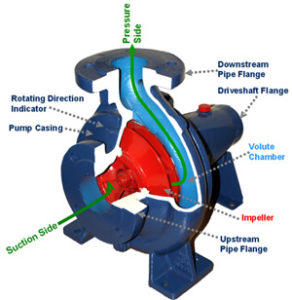
Figure 1: Cross-sectional view of a centrifugal pump. (photo courtesy of Wikipedia)
Figure 1: Cross-sectional view of a centrifugal pump. (photo courtesy of Wikipedia)
Centrifugal pumps (Figure 1) are widely used in thermal fluid applications. These pumps rely on an impeller with rotating blades to generate velocity and move fluid through the system.
Some centrifugal pumps are engineered specifically for thermal fluids. They feature robust construction, enclosed impellers, high-quality seals, and can withstand temperatures up to 850°F (454°C), making them well-suited for demanding applications.
They also offer flexibility in design, giving you the option of sealed or sealless configurations.
Positive displacement pumps (Figure 2), though less common, are typically used in smaller, electrically heated systems. Often called gear pumps, they work by trapping fluid between gear teeth and forcing it outward into the system. These pumps generally use mechanical seals.
Whichever type you choose, confirm with the manufacturer that it is compatible with thermal fluids. Avoid standard process pumps—they’re usually not rugged enough and often underperform in heat transfer applications.
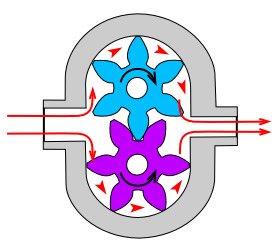
Figure 2: A positive displacement pump. (photo courtesy of Wikipedia)
Figure 2: A positive displacement pump. (photo courtesy of Wikipedia)
Several manufacturers focus on pumps designed for thermal fluids. Dean Pump Division, MP Pumps, Inc. and Teikoku/Chempump are but a few examples for centrifugal designs. Viking Pump is one possibility if you need a positive displacement pump.
Some manufacturers also provide custom design services and assistance in determining the correct pump size. Sizing is crucial—your pump must be strong enough to manage the fluid’s viscosity and move it effectively throughout the system. If the pump is undersized, “low flow” can occur, leading to pump cavitation, reduced performance, and elevated film temperatures that quickly degrade fluid.
In short, the pump’s horsepower is key—a properly sized unit ensures there’s enough flow for the system to function efficiently.
Another often-overlooked factor: make sure your pump can handle the fluid’s viscosity at ambient (startup)temperatures, not just at operating (output) conditions. If it can’t, circulation may stall during startup, leaving the fluid vulnerable to overheating.
These are general guidelines, but the best results come from working directly with engineers and pump manufacturers to select the right pump for your system.
Have questions or comments? Please let us know.

Learning Center

Heat Transfer Fluid Maintenance and Change-Out Guide
With thousands of thermal fluid applications, exact oil change schedules ... Read more
Procédures appropriées d'entretien et de remplacement des fluides
Avec littéralement des milliers d'utilisations pour les fluides caloporteurs, il ... Read more

Quelle est la différence entre un nettoyant de chasse d'eau et un nettoyant de système ?
On nous demande souvent un liquide de rinçage alors qu'il ... Read more
Thermal Fluid Disposal and Recycling
Every thermal fluid eventually needs replacement. Here’s a summary of
Duratherm Fluid Analysis: Now with Enhanced Capabilities
Duratherm already offers one of the industry’s most comprehensive fluid
Working with Open Baths: Key Considerations
Explore our latest whitepaper focused on best practices for open

